Rosen's foreword in Savageau's "Biochemical systems analysis: a study of function and design in molecular biology"
What you see next is a little foreword by Robert Rosen in Michael Savageau’s Biochemical Systems Analysis: A Study of Function and Design in Molecular Biology (1976), which can very well be seen as a foundational resource to Biochemical Systems Theory:
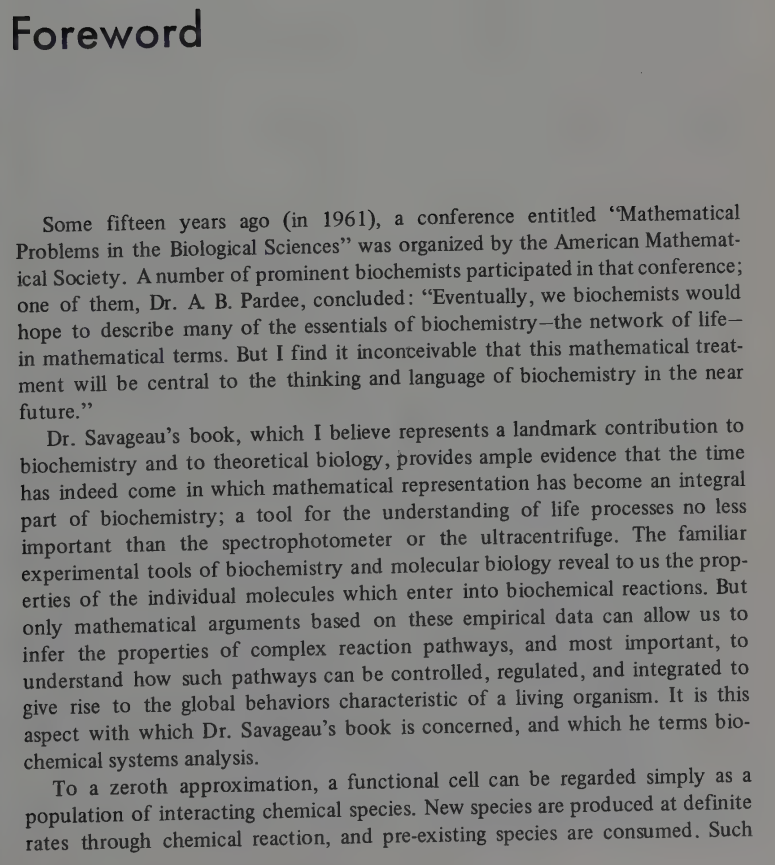
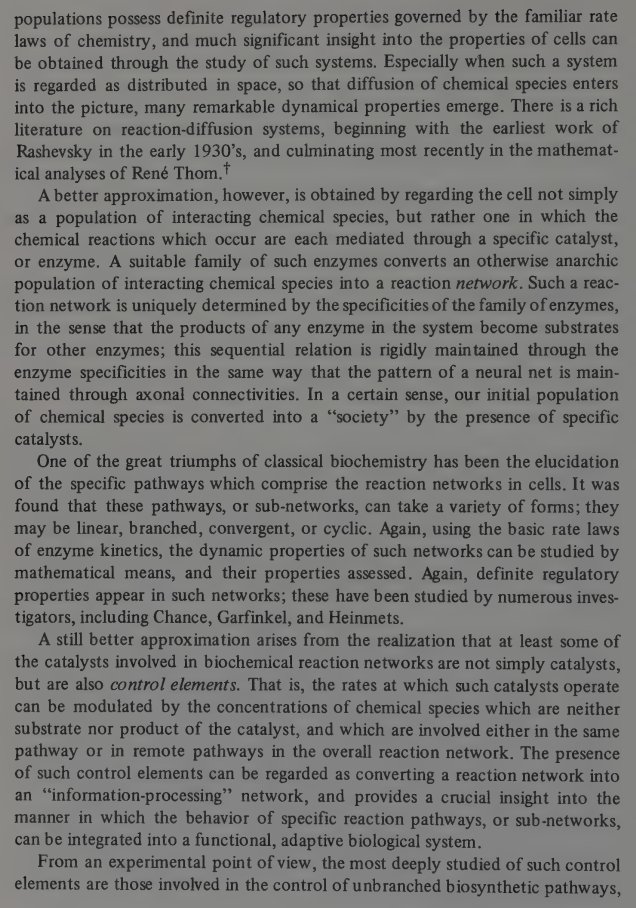
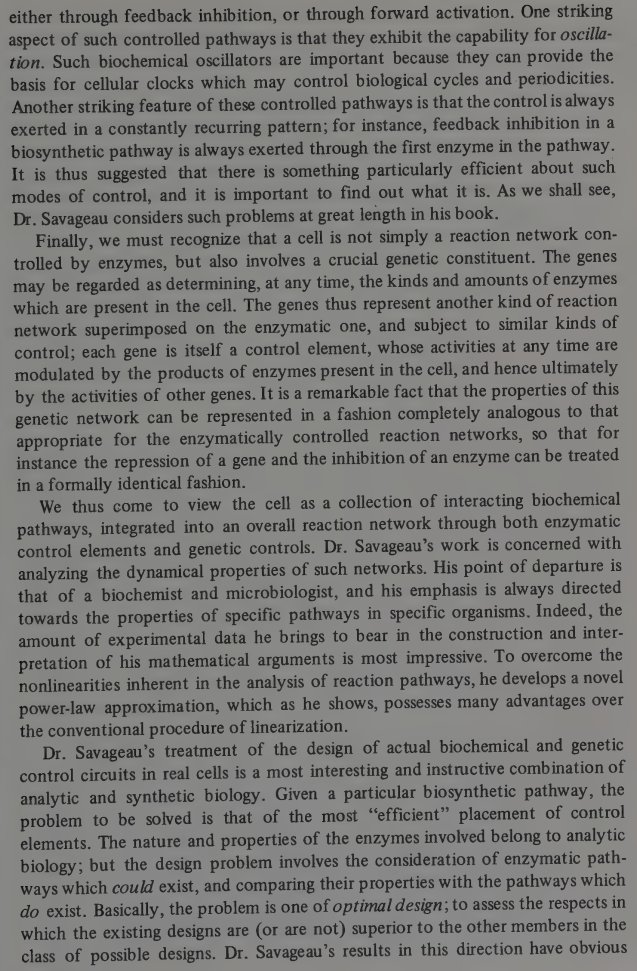

My intent here is to make a few very brief remarks on Rosen’s foreword, from the start highlighting the time of Rosen’s writing of this foreword. This is largely before both the writing of Anticipatory Systems: Philosophical, Mathematical, and Methodological Foundations (1985) and (more particularly) of Life Itself: A Comprehensive Inquiry Into the Nature, Origin, and Fabrication of Life (1991) (abbreviated as LI), which could be described as being a remarkable departure from the sentiment seen in the respective foreword.
Consider the following (LI, pg.244):
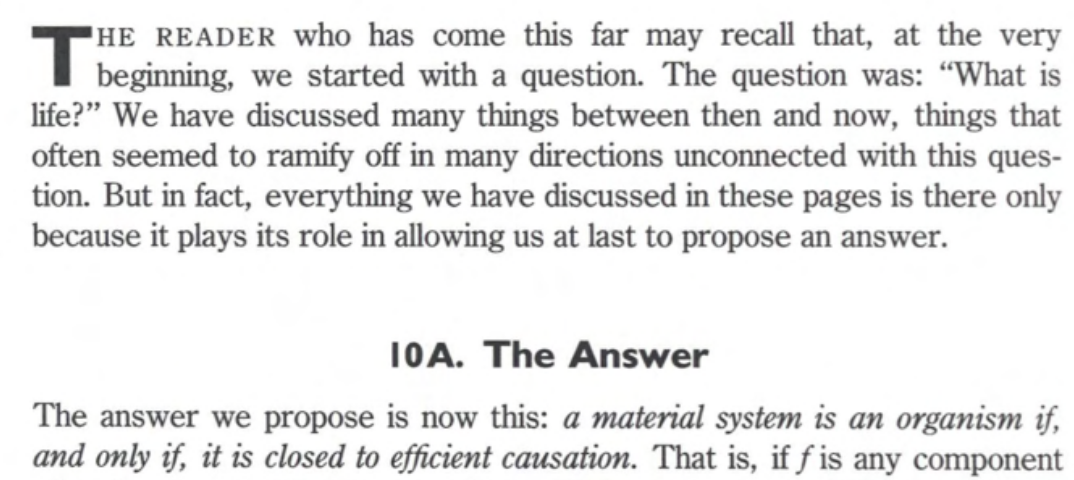
with emphasis on
The answer we propose is now this: a material system is an organism if, and only if, it is closed to efficient causation.
this generally being what Rosen considers to be the organism’s general case. Any physical system which is to be deemed an organism, must produce every constraint (or every efficient cause) from within itself. One also has a set of very similar concepts (e.g. closure of constraints), under the organizational account, being derived from some of Rosen’s considerations. I’ve also written/(been writting) some short and rather rant-ish notes on some of these things in order to solve some of my present confusion, such that some of these short remarks might be considered as a development.
Rosen’s intent on LI was to dwelve on the general case (and on the presumable limitations of current tools in capturing such general case, or the particular organization organisms show). A perfect motivation for this undertaking is present in the next few excerpts (in LI pg.111-12), where Rosen comments on a few remarks made by his mentor Nicolas Rashevsky after approximately 2 decades of research in mathematical biology (predominantly as a key pioneer and large founder of such field):

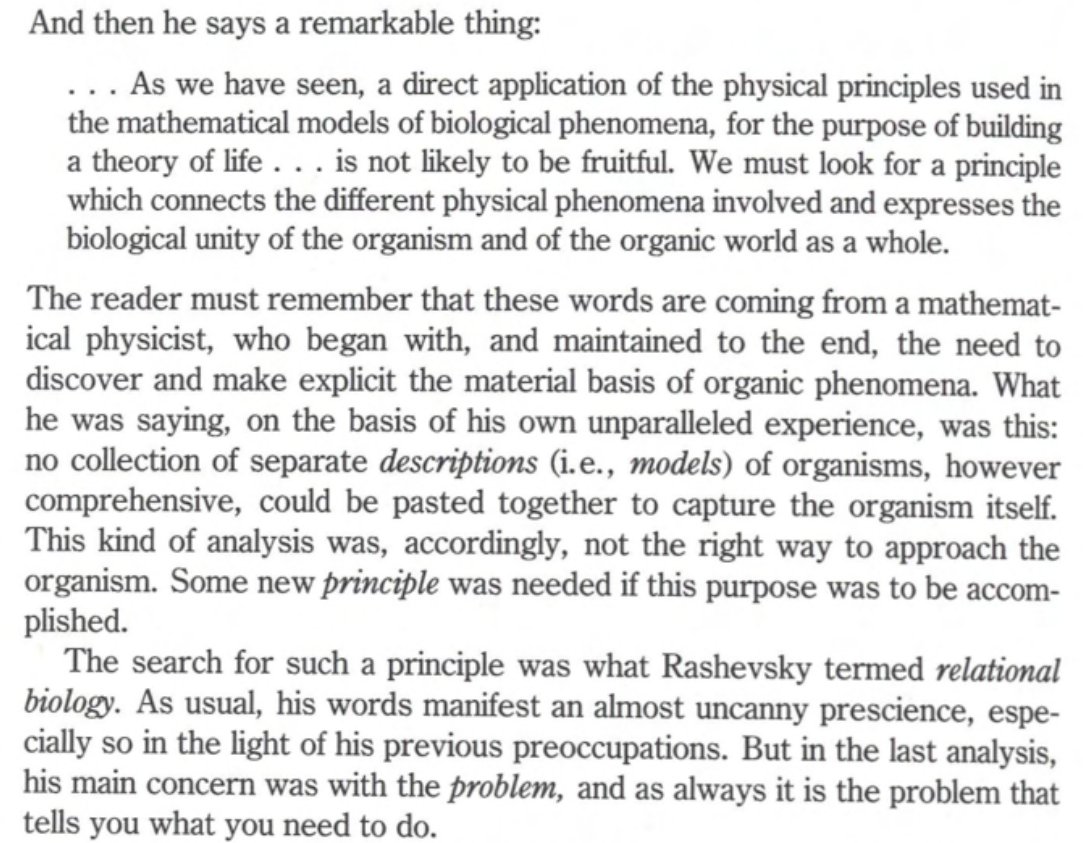
and additionally on pg.113:

Rosen’s overall assessment can be generally put as remarked by him much earlier (pg.37), in a chapter about the special(ization) and the general(ization):
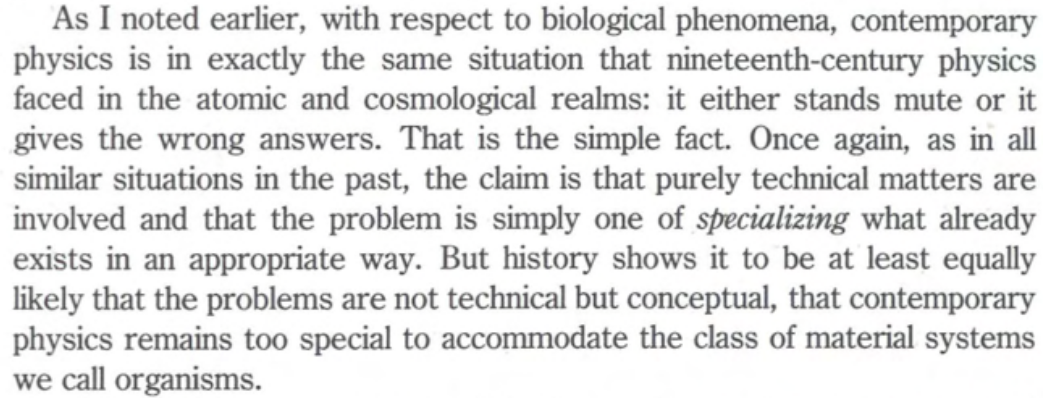
And so the question is: has much changed with regards to this? Is the organism (as a general case) an object (or process) which is still out of reach to study? If so, why is that the case?
We can look back at that small foreword written by Rosen, and draft an even better approximation for a typical system like a cell, which will include and reflect majority of our understanding of these physical systems through (sub)fields which have more recently found reasonable success in the description of processes happening in cells (e.g. stochastic thermodynamics, soft condensed matter physics, etc). We can combine these approaches with others which attempt to model majority of the cell’s processes from a kinetics perspective - be them majorly phenomenogically-based or actually taking into account the underlying mechanisms, in order to reflect a bit better what a cell does. Not only does it have a robust kinetic control over its components, but the same can be said for the spatial counterpart. The diffusion constraints a component faces, will inherently modulate the rates such component might possibly be affecting.
And yet… Where is the organism?